
 See Our Latest Article on HelloNation

Golf places repeated demands on the lower back, hips, shoulders, wrists, and neck. A full swing combines rotation, balance, weight transfer, and speed, often repeated dozens of times during practice or a round. Chiropractic care may help some golfers move more comfortably and address joint or muscle-related limitations, but it works best as part of a broader plan that includes conditioning, swing technique, recovery, and appropriate medical evaluation.
Can chiropractic care improve golf performance?
It may improve aspects of movement that support a more consistent swing, especially when pain, stiffness, or restricted mobility is affecting posture and rotation. Chiropractic care does not directly make a golfer stronger or automatically correct swing mechanics. Its potential value is helping identify musculoskeletal problems that interfere with the movements required for golf.
A golfer may notice benefits such as:
- Improved spinal, hip, or shoulder mobility
- Less stiffness after practice or a round
- Better tolerance for walking and repeated swings
- More comfortable setup and follow-through positions
- Improved awareness of posture, balance, and movement
- Easier participation in strengthening or mobility exercises
These changes can support performance indirectly. If a player is protecting a painful area, the body may adjust the swing by reducing rotation, shifting weight unevenly, or relying too heavily on the arms. Such compensations can affect consistency and may place extra stress on another region.
Why does golf commonly cause back discomfort?
The golf swing produces rapid trunk rotation while the spine is bent slightly forward. The lower back must help transfer force between the legs and upper body, particularly during the transition from backswing to downswing.
Back discomfort may be related to several factors:
- Limited hip rotation
- Stiffness in the mid-back
- Weakness or poor endurance in the abdominal, hip, or back muscles
- Sudden increases in practice or playing time
- Repeated swings from uneven ground
- Poor recovery between rounds
- Prolonged sitting before or after golfing
- A swing change that increases strain
There is no single “perfect” swing position that prevents all injuries. Golfers differ in age, flexibility, strength, previous injuries, and playing style. A movement that is comfortable for one person may aggravate another.
For local residents, seasonal changes can also affect preparation. After spending much of the colder months less active, returning to the course or driving range at full intensity can overload tissues that are not ready for repeated rotation. A gradual spring buildup is usually more sensible than treating the first warm weekend as a full-season test.
What might a chiropractor evaluate?
An evaluation may consider how the spine, hips, pelvis, shoulders, and extremities work together during basic movements. The goal is not to diagnose a golf swing from a single posture but to look for restrictions, pain patterns, asymmetries, and movement strategies that may affect activity.
Common areas of focus can include:
Spinal mobility
Restricted movement in the mid-back may cause a golfer to rotate excessively through the lower back or neck. Improving comfortable thoracic movement may reduce the need for compensation.
Hip function
The hips contribute to turning, weight transfer, stability, and the ability to maintain posture. Limited hip mobility or reduced hip strength can make the lower back work harder.
Pelvic and lower-extremity control
The legs and pelvis provide the foundation for the swing. Weakness, balance problems, or difficulty controlling the knees and hips may affect both the backswing and follow-through.
Shoulder and upper-back movement
Shoulder restrictions may make it difficult to complete a comfortable backswing. The body may compensate by arching the lower back or lifting the shoulder excessively.
Pain response and activity tolerance
A useful assessment considers what happens during a swing, after several swings, later that day, and the following morning. Symptoms that steadily worsen with activity deserve more attention than mild stiffness that resolves quickly.
What does treatment usually involve?
Treatment depends on the findings and the golfer’s goals. Chiropractic care may include manual techniques intended to improve joint motion, soft-tissue work, mobility exercises, stabilization exercises, and advice about modifying activity.
A responsible plan should be connected to function. For example, rather than focusing only on a stiff joint, care may address whether the golfer can:
- Rotate comfortably in both directions
- Maintain a balanced setup
- Hinge at the hips without rounding excessively
- Walk and practice without increasing symptoms
- Perform a controlled half-swing before returning to full swings
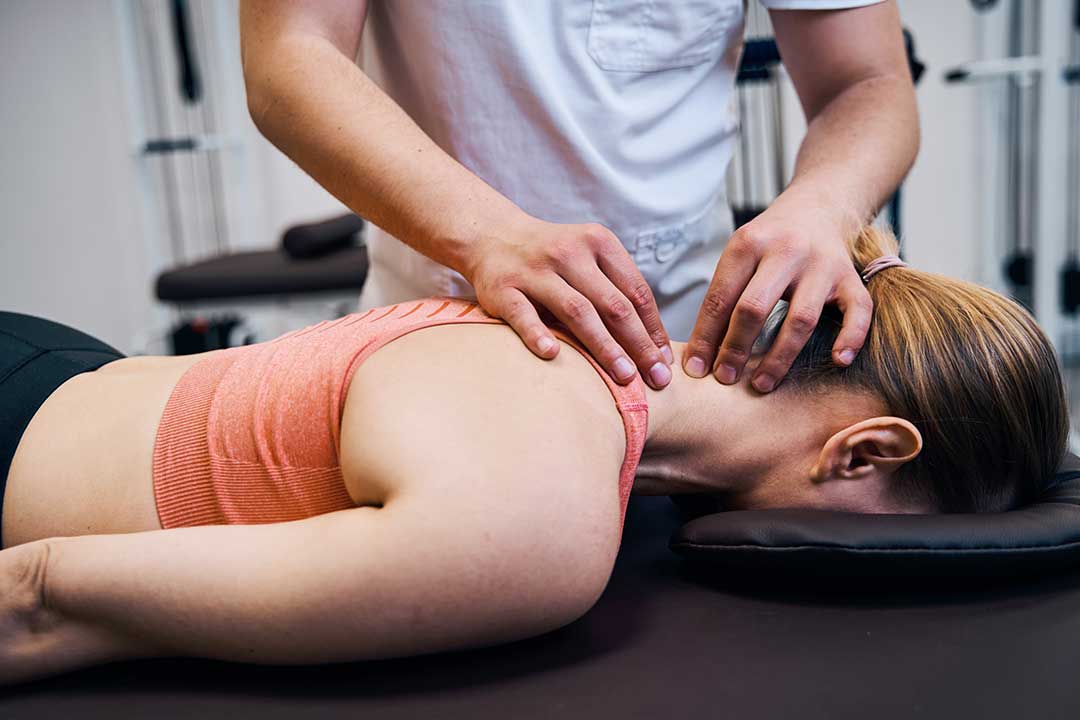
Adjustments are not appropriate for every person or every condition. They should not be presented as a cure for disc problems, arthritis, nerve disorders, fractures, or serious underlying disease. Exercise, physical therapy, medical care, or a combination of approaches may be more suitable depending on the problem.
How can golfers prepare before playing?
A short warm-up can help the body transition from rest to activity. It should raise body temperature and rehearse the movements used in golf without causing pain.
A practical routine may include:
- Five to ten minutes of brisk walking
- Gentle trunk rotations
- Hip hinges
- Controlled bodyweight squats
- Alternating lunges
- Shoulder circles and arm swings
- Gradual practice swings, beginning with short swings
Starting with a few easy swings using a wedge or short iron allows the body to warm up before faster, longer swings. Repeatedly hitting a driver at full speed without preparation can place unnecessary stress on the back and shoulders.
Can chiropractic care replace golf instruction or strength training?
No. Chiropractic care and golf instruction address different needs. A golf instructor may help with grip, stance, sequencing, club selection, and technique. A qualified exercise professional may help build leg strength, trunk endurance, balance, and rotational control.
Chiropractic care may complement those efforts when pain or restricted movement is limiting participation. It should not be used to avoid addressing a swing flaw, inadequate conditioning, or excessive practice volume.
Strength and endurance are especially relevant for golfers who play only on weekends. A body that can perform one strong swing may not tolerate 80 to 100 swings without fatigue. Fatigue can change posture and timing, increasing the chance of aggravating an existing problem.
When should back or joint pain be medically evaluated?
Golf-related soreness should not be ignored if it is severe, persistent, or progressively worsening. Medical evaluation is particularly important for pain accompanied by:
- Numbness, tingling, or weakness
- Pain traveling down an arm or leg
- Loss of coordination or balance
- Changes in bladder or bowel control
- Fever, unexplained weight loss, or unusual illness
- Pain after a significant fall or impact
- Night pain that does not improve with position changes
Sudden chest pain, shortness of breath, fainting, or severe neurological symptoms require urgent care rather than routine treatment.
For less serious symptoms, temporarily reducing full-speed swings, avoiding painful positions, and returning gradually may be reasonable. Pain that continues to interfere with walking, sleep, daily activities, or the golf swing deserves a proper assessment.
The most useful role of chiropractic care for a golfer is practical: helping determine whether stiffness, pain, or movement limitations are contributing to difficulty on the course, then pairing appropriate care with gradual exercise, sound technique, and adequate recovery. The result may be a more comfortable swing and a more sustainable approach to playing throughout the season.
